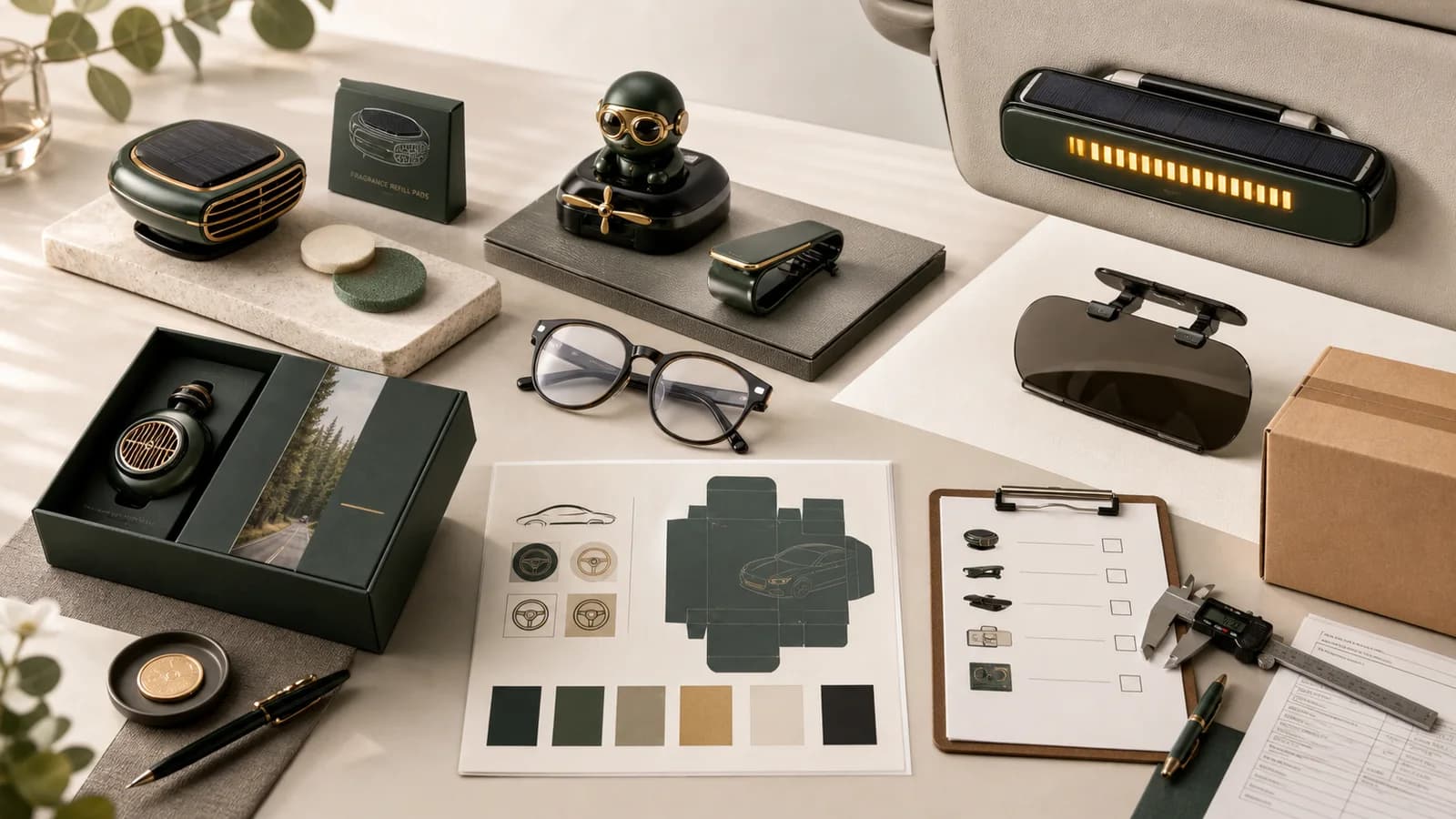
Car-air-freshener packaging has to do several jobs at once: protect the product and fragrance carrier, identify the exact variant, tell the user how to handle it, support retail or distribution records, and carry market-specific information supplied by the responsible business. A visually attractive box cannot repair missing classification, traceability, language, or instruction decisions. Because fragrance products can sit at the boundary between an article, a mixture, and a combined packaged product, the buyer should not copy a competitor’s panel. Start with the exact formulation, intended use, destination, and business roles, then build the pack around the resulting brief.
Start with LANDRE's custom car air freshener wholesale options to identify relevant product families, then use this guide to turn a visual shortlist into a decision-ready brief. The commercial page is a route to product evidence and an RFQ, not a substitute for sample approval or market-specific compliance review.
The Buying Decision in One Paragraph
Build car-air-freshener packaging from the exact product and formulation classification outward: identify the responsible parties and market, define required information and claims, then approve legibility, sealing, product protection, and traceability on a complete sample.
A useful decision separates what is known, what must be measured, what the buyer must choose, and what a qualified compliance or logistics specialist must confirm. Record assumptions in writing. If a supplier changes a material, mechanism, fragrance, artwork revision, package, or route, reopen the affected approval instead of relying on an old photograph.
Decision Criteria That Change the Result
Determine the Product and Business Roles First
Identify the product body, fragrance carrier or mixture, refill, consumer unit, importer, brand owner, manufacturer, distributor, and target market. Ask a qualified adviser which rules apply to each element and who is responsible for classification, documentation, label content, notifications, and market placement. The factory can print approved information but should not invent the legal brief.
Evidence to retain: Product composition map, formulation reference, intended-use statement, destination list, responsible-party record, and written compliance brief.
Separate Mandatory Information From Marketing Copy
Create a controlled information table before the designer works on hierarchy. Include identifiers, quantity where relevant, responsible-party details, origin or importer information where required, use and replacement instructions, warnings, disposal, languages, and traceability. Place optional scent story and campaign copy only after required content has enough legible space. Do not use certification, eco, duration, or safety claims without evidence.
Evidence to retain: Approved content table, claim evidence file, language review, legal or compliance sign-off, and dated artwork copy.
Approve the Complete Pack and Distribution Levels
Test the consumer box, internal seal, refill containment, inlay, insert, barcode zone, inner pack, and export carton together. Check that the product cannot move into damaging contact, fragrance does not compromise printed surfaces, and the user can open the pack without destroying necessary information. Retail and warehouse teams should verify identifiers and scanning where applicable.
Evidence to retain: Complete package sample, drop or handling plan where required, barcode verification, carton data, photographs, and signed pack approval.
Use the LANDRE product catalog to compare named SKUs and preserve the product ID in the brief. For product, logo, packaging, and fit questions that cannot be resolved on screen, move the shortlist into the physical sample kit workflow.
Specification and Evidence to Send the Supplier
A supplier cannot quote or reproduce details that remain implicit. Put the following information in one controlled request, give every artwork and specification file a revision, and ask the supplier to identify any unsupported assumption before pricing.
- Exact product, fragrance carrier or mixture, formulation reference, intended use, destination, and consumer-unit definition.
- Manufacturer, importer, brand owner, supplier or responsible-party information assigned by the applicable market brief.
- Product identifiers, net or nominal quantity where applicable, lot or batch traceability, origin, and barcode or SKU space.
- Use, installation, replacement, storage, disposal, warning, and first-response information required for the product and market.
- Claims register linking each fragrance, performance, material, environmental, quality, or certification statement to evidence.
- Consumer pack, unit seal, inlay, insert, refill pack, inner pack, carton, languages, artwork revisions, and final dimensions.
The factory workflow shows where the RFQ, artwork proof, sample, production, inspection, and export evidence belong. Use the factory FAQ to resolve standard process questions, then place product-specific exceptions in the written quote.
Approval Workflow From Shortlist to Production
1. Build the compliance input table. Collect product, formulation, intended use, market, role, language, instruction, warning, traceability, and claim decisions before layout.
2. Design information hierarchy at final size. Reserve legible space for required content, then add branding and campaign copy without hiding or contradicting the approved information.
3. Approve a complete printed pack. Check text, language, colour, barcode, seal, product fit, fragrance contact, opening, inner pack, and carton on physical samples.
4. Control production and future revisions. Link artwork to product and formulation versions and require review after any market, supplier, formula, pack, claim, or address change.
Do not let approval live only in chat messages. Keep the final quote, artwork proof, physical-sample decision, packaging revision, inspection plan, and delivery instruction in the same order record. The detailed MOQ and sample approval guide explains how quantity tiers and approval gates should stay connected.
Risk Controls and Authoritative References
The main risks for this decision are predictable when the team names them before purchase:
- Copied competitor label: Develop the content from the exact product, formulation, responsible roles, destination, and current advice rather than another brand’s pack.
- Unsupported claims: Maintain a claims register and remove broad safety, environmental, duration, certification, or performance statements without adequate evidence.
- Legibility failure: Print at final size, review required languages and contrast, and do not rely on a zoomed design file as proof.
- Artwork and product drift: Tie product, formulation, pack, and artwork revisions together and reopen review when any controlled input changes.
Use the current fragrance-industry risk-management material to discuss intended use with the responsible fragrance supplier and compliance adviser; it does not replace destination-market law. Review the IFRA Standards with the responsible specialist before the order is released.
For EU-bound mixtures, first determine classification and the responsible supplier role, then verify whether CLP label or packaging duties apply to the exact formulation and pack. Review the ECHA labelling and packaging guidance with the responsible specialist before the order is released.
These sources are starting points, not certificates for a LANDRE product and not legal advice. The importer, brand owner, marketplace, carrier, and destination-country adviser should confirm which duties apply to the exact product, formulation, claims, packaging, and route.
Budget, MOQ, and Timeline Controls
Packaging quotations should identify dieline development, artwork adaptation, plate or tooling, proof, printed samples, unit seal, inlay, insert, consumer box, inner pack, carton, barcode verification, and any language versions. A multi-market pack may save inventory but increase text density and review time. Compare that tradeoff with market-specific sleeves or labels. Do not release bulk printing before the product, formulation, content table, and final-size proof are approved, because obsolete packaging can cost more than the product it was meant to protect.
Compare quotations on the same configuration. Separate unit price from artwork, tooling, samples, packaging, inspection, freight, duty, tax, distribution, and replenishment. Reserve time for buyer feedback and sample revision; a production lead time quoted before the artwork and sample are approved is not the same as a committed delivery date.
RFQ Checklist and Practical Next Step
Before sending the request, confirm:
- Product, formulation, intended use, consumer unit, destination, and responsible roles.
- Controlled information table with identifiers, traceability, instructions, warnings, and languages.
- Evidence register for every performance, environmental, certification, material, and safety claim.
- Final-size artwork with approved hierarchy, colour, barcode zone, addresses, and revision.
- Complete physical pack covering seal, fit, inlay, insert, refill, inner pack, and carton.
- Retail or warehouse identifier and scanning review where applicable.
- Change-control trigger for market, formula, product, supplier, claim, address, or pack revision.
Use the retail packaging and barcode guide for the adjacent decision, then send LANDRE a structured inquiry with the product IDs, quantity, market, artwork, package, deadline, and unresolved questions. A precise brief produces a more comparable quote and a safer approval path than asking only for the cheapest unit price.